Fashion-MNIST · Ace Data Cloud

Fashion-MNIST Fashion Image Dataset:
A Modern Benchmark for Image Classification

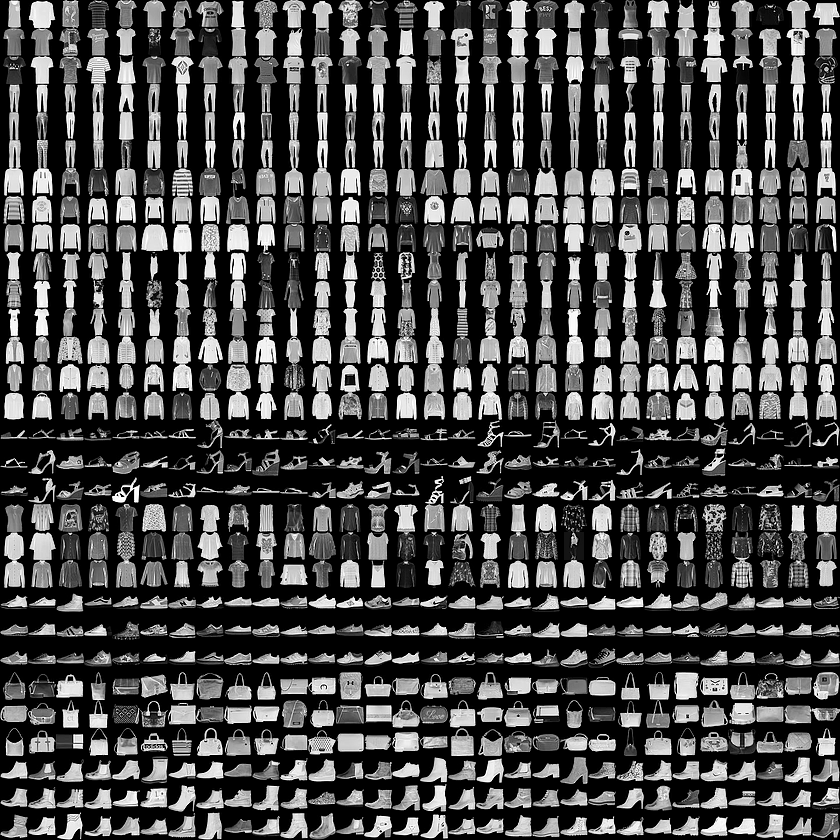
A fashion product image dataset released by Zalando Research. 70,000 28×28 grayscale images, 10 categories—serving as a direct replacement for the classic MNIST and providing a more challenging benchmark for image classification research.

Fashion-MNIST Fashion Image Dataset
Four ZIP files · Includes IDX.GZIP MIT License Fully Compatible with MNIST Format
🖼️
70,000
Images
👗
10
Categories
📐
28×28
Resolution
💾
30MB
Data Size

Dataset Highlights

Fashion-MNIST is becoming the new standard benchmark dataset in image classification

🔄

MNIST Replacement

A direct replacement for classic MNIST, compatible with the same file formats, data structures, and toolchains, allowing you to switch without modifying any code.

👕

Fashion Products

Real clothing images (T-shirts, trousers, dresses, coats, etc.), offering greater visual diversity and classification challenges than handwritten digits.

📜

MIT Open Source

Uses the permissive MIT License, freely available for both commercial projects and academic research; the original copyright and license notice must be retained when redistributing.

📦

Standard Format

Training/test images and labels each have separate ZIP files, containing raw IDX.GZIP files, the MIT License, and a source manifest; IDX tools can read them after extraction.

📊

Moderate Difficulty

More difficult than MNIST but simpler than CIFAR-10, making it ideal for transitioning from beginner to advanced learning and for model tuning experiments.

⚡

Framework Support

PyTorch, TensorFlow, and Keras all provide built-in support; load the dataset with a single line of code and use it out of the box.

Use Cases

From academic research to industrial applications—common uses of Fashion-MNIST

🤖

Image Classification

CNN, ResNet, Vision Transformer—the preferred benchmark dataset for validating various image classification models

🏆

Model Benchmarking

Compare the accuracy, parameter count, and inference speed of different network architectures on standardized data

🔬

AutoML Evaluation

Used to evaluate the performance of automated machine learning frameworks and validate automatically discovered optimal model architectures

👗

Apparel Recognition

Prototype validation for product classification in fashion e-commerce scenarios, enabling rapid development of apparel image recognition MVPs

Data Preview

Fashion-MNIST contains grayscale images of fashion items from 10 categories

Categories
Label    Category Name      Description
───────────────────────────────────────
 0     T-shirt/top      T-shirt/top
 1     Trouser          Trousers
 2     Pullover         Pullover
 3     Dress            Dress
 4     Coat             Coat
 5     Sandal           Sandal
 6     Shirt            Shirt
 7     Sneaker          Sneaker
 8     Bag              Bag
 9     Ankle boot       Ankle boot
60,000 training images 10,000 test images 28×28 grayscale pixels 10 categories IDX binary format

Get Started in 3 Quick Steps

From browsing to using, it only takes a few minutes

01

Browse the Dataset

View detailed descriptions, category definitions, and data previews for the Fashion-MNIST dataset on the Ace Data Cloud platform.

02

Check Delivery Status

Four private ZIP files with licensing information are ready, but self-service purchase and download are not yet available; first review previews of the actual images and label distributions for each item.

03

Load and Train

Load the data with PyTorch, TensorFlow, or Keras in one line of code and start training your image classification model.

Python
import torch
import torch.nn as nn
import torch.optim as optim
from torchvision import datasets, transforms
from torch.utils.data import DataLoader
# 数据预处理
transform = transforms.Compose([
    transforms.ToTensor(),
    transforms.Normalize((0.5,), (0.5,))
])
# 以下 torchvision 示例单独从公开来源下载,不读取平台交付 ZIP
# 加载 Fashion-MNIST 数据集
train_data = datasets.FashionMNIST(
    root="./data", train=True, download=True, transform=transform
)
test_data = datasets.FashionMNIST(
    root="./data", train=False, download=True, transform=transform
)
train_loader = DataLoader(train_data, batch_size=64, shuffle=True)
test_loader = DataLoader(test_data, batch_size=64, shuffle=False)
# 定义简单的神经网络
class FashionNet(nn.Module):
    def __init__(self):
        super().__init__()
        self.flatten = nn.Flatten()
        self.fc1 = nn.Linear(28 * 28, 256)
        self.fc2 = nn.Linear(256, 128)
        self.fc3 = nn.Linear(128, 10)
        self.relu = nn.ReLU()
    def forward(self, x):
        x = self.flatten(x)
        x = self.relu(self.fc1(x))
        x = self.relu(self.fc2(x))
        return self.fc3(x)
model = FashionNet()
criterion = nn.CrossEntropyLoss()
optimizer = optim.Adam(model.parameters(), lr=0.001)
# 训练模型
for epoch in range(5):
    model.train()
    for images, labels in train_loader:
        optimizer.zero_grad()
        outputs = model(images)
        loss = criterion(outputs, labels)
        loss.backward()
        optimizer.step()
# 评估准确率
model.eval()
correct, total = 0, 0
with torch.no_grad():
    for images, labels in test_loader:
        outputs = model(images)
        _, predicted = torch.max(outputs, 1)
        total += labels.size(0)
        correct += (predicted == labels).sum().item()
print(f"测试准确率: {100 * correct / total:.2f}%")  # 约 88%


Start Your Image Recognition Journey

You can first view verified real images and label distributions; purchase and licensed downloads will be available after full verification.